Friday, August 16, 2013

How Do We Know When the Piece of Art is Finished?

The original to this title was written almost two years ago, in September, 2011.  Scroll Down a few blog entries to read the original.  (It's about a gorgeous piece of art at the half-way point that was made clumsy-looking when completed.  Somebody had the wisdom to photograph the piece at its point of beauty. But we didn't know it couldn't be replicated later and we didn't anticipate completing it would render it thick and ordinary.)

  Then it was another 17 months before I added my next update.  In the interim I was found to have advance stage ovarian cancer.  Major surgery, immediately followed by major chemotherapy.  There were six chemo infusions that kept me sick for about 5 months more. Later, about 5 months after the end of chemo, monthly blood tests started to show a rise in CA-125# that could indicate cancer.  After three months of rising numbers a CAT scan was ordered that showed no visible internal changes.  Ten weeks later a PET scan (more detailed imagery) showed three areas of suspicious activity.  Metastases along my aorta, liver, and in the lymph nodes, left groin area.  They're small, the size of little Rice Krispies.  They were found in March, 2013.

Since April 5, 2013, I am back on chemotherapy. Oh, but wait, there's more.  My husband suffered a major heart attack on the night of March 31/April 1.  I had to leave his intensive care bedside to run to another hospital for a pre-chemo test. He started out in terrible shape, but he has recovered very well and has stents installed.  We are no strangers to stress-related illness.  Routine exercise is now our friend (both of us when my strength permits).  Matt is now healthy and strong again.

The side effects from chemo can be bizarre, the treatment for this disease is beyond barbaric.  And the costs are ridiculous.  I was just informed that health insurance may now have a lifetime limit of 4 PET Scans. Patients would have to pay out of pocket for any more than that. This one coming up is #3.  If I max out the limit I may have to pass the hat or die from undetected and therefore, untreated, cancer.  My doctor said once before, "I can't treat something I can't see."  Go ahead and look up how much PET scans cost patients vs. insurance companies.  I might need to research what's available in Canada.  We're only an hour away from Windsor, Ontario.

So, How do we know when a piece of art is finished? What if it's my life we're talking about?  Is it when the treatments can not cure, but can still prolong a life (of repeated suffering)?

There is some indication that the chemo has stopped shrinking the tumors - based on the oft-unreliable CA-125#.  There is a slight rise last month after very little decrease the previous month.  My number is 129.  Up from 127.  It's better than the 279 I started with in April, but very far off the safe-range goal 0-35.

I may have more chemo.  Maybe different chemo meds.  I don't know what's next.  I will know more in late September.

I have no control over any of this.  I try everybody's wacky cures, eat this, drink that, juice these specific vegetables, take these supplements, [don't take supplements, they'll interfere with chemo], zap electricity to your meridians, get acupuncture, [acupuncture is worthless], ginger works in a petri dish on rat's prostate tumors, rest, [no, you should exercise], avoid meat, [no, you have to rebuild your damaged bone marrow, you should eat meat], smile, cry, [don't cry], read, [don't read that!]  

Oh, you're anxious?  We have pills for that.

On one of those days that I couldn't stop crying I asked the question, "Is it worth living like this if all I can do is cry?" and the answer I got was "Yes."


Sunday, March 3, 2013

Digital Story

With the help of a fellow art therapist, Sibel Ozer, I put together this digital story.  A Little Window of Time This link takes you to my website where the story is posted.  When you go there, click the "full screen" option at the lower right hand corner of the story (after you click the arrow to start playing the story).  It looks better in full-screen.  I am lucky in that all the music was created by family members and given to me to use with copyright permission. The art and photographs came from me.  And the narrative.  The story is under 4 minutes.
I have SO MUCH art from my period of illness last year.  It was hard to cull the collection down to the few pieces shown in the story.  I hope you view the story and that you leave comments here.
Many Blessings to you all,
Susan


Thursday, September 15, 2011

How Do We Know When a Piece of Art is Finished?


I was in a sculpture class in high school and our assignment was to make a plaster sculpture that required an armature. An armature is a structure that supports the piece from inside and is never seen once the piece is finished. We were provided with blocks of wood for the bases and various gauges of wire, chicken wire, wire cutters, etc. with which to construct this supporting structure.
One of my classmates, let’s call her Linda Yen, created an armature of a horse that was so lovely the teacher called a halt to the class. Everybody was gathered around (the way I remember it) for a discussion about what to do next. The armature was so beautiful that the question arose as to whether the piece could be called complete at this stage. The instructor asked the philosophical question – one I still use every day -“How do we know when a piece is finished?” What a great question! The teacher was wise enough to let the student decide whether and how to proceed with the assignment. I remember some of the options:
· Leave this one as-is and call it complete.
· Finish the piece as assigned (cover it in plaster bandage and then more plaster). The sub-text to this was that if it loses something, she could attempt to make another wire sculpture.
· Stop now and create another companion armature to cover in plaster.
There were so many possible outcomes. The piece could look even more gorgeous when plastered, but there was no guarantee. What if it looked worse? None of us knew for sure what would happen. What if she were unable to create another equally graceful armature? I remembered the instructor taking a photograph of the armature “just in case.” It turned out the student chose to cover the armature in plaster as originally assigned. It lost its grandeur, appearing heavy and clumsy when it was finished. I remember her attempt to remake a wire armature afterward. It, too, lacked the beauty of the original.
I always took it as a lesson: When something looks really lovely, maybe it’s time to call it complete. Maybe it’s not what you were expecting, but try to step back from the “assignment” (your preconceived notions, your original expectations) to see the piece for what it is. If it is a treasure, treasure it.
I didn’t realize how deeply impacted I was by this learning. Let’s face it. Most of us in high school don’t learn by others’ mistakes – we much prefer to make our own. I know I did. I was truly impressed with Linda Yen’s original sculpture. I was equally disheartened by her loss in finishing the sculpture with plaster in a way that dulled its elegance, and then by her struggle to re-create another fine armature that also fell somewhat short.
Cut 42 years into the future:
Last week my friend Peter started posting digitized slides he rescued from our old high school in the midst of its demolition. In typically wasteful fashion, the venerable old building was being torn down while still full of books, supplies, furniture, art, and, oh yes, a carousel of old slides from the art department. What are the odds Peter would come up with images of the art work made by our cohort in the late 1960s? He did.
This is a photo of my life lesson. This is a slide of Linda Yen's armature from 1969. How do we know when a piece of art is finished? Is it when the teacher says, "Let me get a picture of this now, just in case?"
The larger lesson from this event is encoded here, too. What if your life isn't what you thought it was going to be? What if you have a different life? Is it possible for you to step back and see its elegance, beauty and completeness? Maybe it's not what you expected, and it has turned into something even finer. Imagine that.

Tuesday, June 21, 2011

Edifice Wrecks


It’s interesting that I am working on a sketchbook with the theme “Time Travel” while this is happening. My old high school in Detroit is being demolished. I think of Robert Frost’s poem (Good Fences Make Good Neighbors) that has the line in it, “something there is that doesn’t love a wall, that wants it down.” This is not the case for old Cass Tech. The destruction of this building is going slowly and painfully. Some of the beautiful 96 year old stonework is being salvaged, and I wonder for what purpose (can I have a piece?) while most of the building and its contents is being turned into rubble. Lockers, labs, auditorium seats, chandeliers, books, desks, windows, plumbing.

Don’t get me wrong, in the late 1960s my friends and I would have loved for the school to disappear so we could have that imagined freedom that idealistic (or fogged-by-pot-smoking) 16 year olds at that time foresaw. Time travel has certainly been fascinating since then. Here we are now: parents, grandparents, doctors, professors, therapists, artists, lawyers. We are as surprised as anybody that we have turned out so, well, grown-up.

On my first day at Cass I knew that my home room was on the sixth floor. I ran up the stairs as I would normally run up a single flight, and I made it to the fifth floor before my legs and lungs responded, “say, what now?” I remember feeling like I couldn’t move one more step and yet I had an entire floor ahead of me. Two flights with a landing between runs of wide marble stairs. Yikes. What do I do? Go back down and look for an elevator? I knew that was a ridiculous option. There was nothing for it but to push myself up those two final flights.

I suppose now that could be read as a metaphor for the rest of my high school experience. The teachers I didn’t get along with, and the teachers I loved (Mr. Caudillo, History! Mr. Matsui, Biology!) And the lifelong friends I collected there. They all pushed me toward learning and growth I would otherwise not have had. The richness and deeply felt joy I treasure from our shared histories is beyond description.

So, back to Cass Tech. I went there last weekend with my husband and walked around its half-demolished husk. Completely fenced off as it was, my mission was to capture a brick from the old building if I could. The perimeter is wide and kept scrupulously picked clean. Hard hat warnings are posted. I found a shard and picked it up. It held so much energy I got goose bumps up my arm. First of all, the building was black when we attended. In the intervening years it had been sandblasted to its original buff color. If I doubted the blond brick piece in my hand was authentic, its juju put to rest that notion. My eyes got wet, my scalp and hand tingled. WTF?

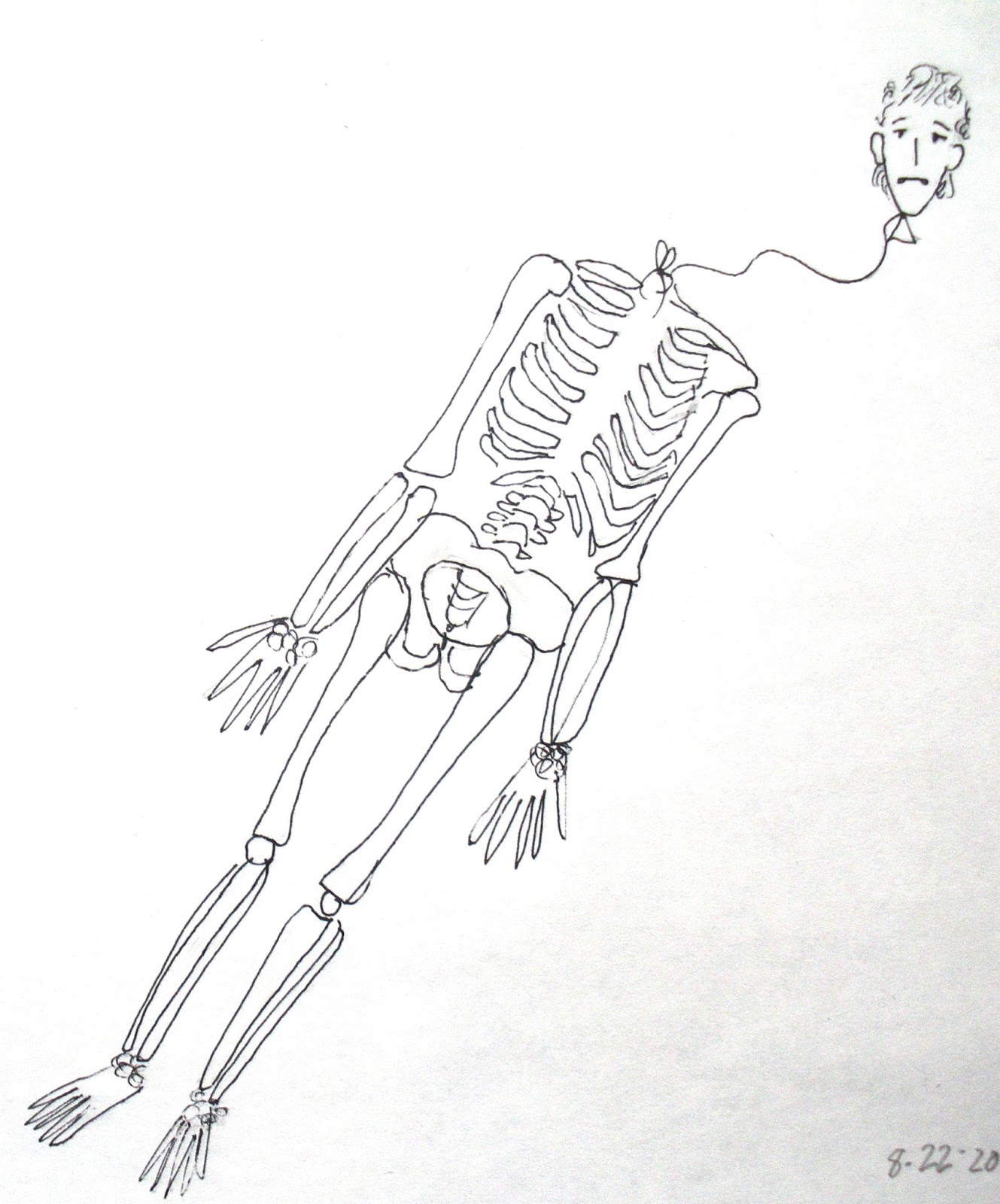
When I attended school there I could NOT WAIT to get out so that my real life could begin. Remember the human skeleton in the figure drawing classroom? We named her Mrs. Nelson after the teacher (old and shriveled, we thought) that retired that first year. Todd remembers smoking weed on the roof and a concurrent struggle with math. I don’t remember the weed (and I don’t remember the math), but I DO remember Todd. I remember walking downtown after school and hanging out at Hudson’s, mostly in the book department where there was access to a hidden back stairway. Hudson’s is also long ago demolished. I remember going to Wayne State University after school and eating French fries in the cafeteria. I remember skipping school and spending time at the Detroit Institute of Arts instead. I remember when my best friend had to bring her little brother to school with her because the babysitter didn’t show up and her mother was already at work. What a crew I ran with. I remember Ellen flinging her leg over a banister and sliding down a flight. She had on a long skirt and sneakers. Tres chic. We all wore skirts to school then, there was a dress code. I remember the elevator operator who told me, “Your eyes favor Bette Davis.”

Back to last weekend at Cass Tech. I found a breach in the chain link fence and walked through it. I took about thirty paces toward the broken building, its large edifice appearing to recede as I attempted to draw near. At just that moment a police car drove by and I heard my husband speak with the officers. Although I couldn’t hear their words, I scooted back out of the enclosure. Yes, the last two police officers still employed in the city of Detroit found me breaking the law! My luck remains consistent. As it turns out they weren’t threatening to arrest us for trespassing, they just passed on a warning “tell her to be careful.” But I was too distressed to carry on. I left with a shard of brick and these pictures. Cass Tech is still teaching me things: now it’s about time travel.

Monday, February 7, 2011

Multi-Generational Impact of Art Therapy

I go to the homes of my clients when necessary due to their mobility limitations. I visited a client today, I’ll call him Steve, but that’s not his real name. Steve is recovering from traumatic brain injury (TBI). Steve also has severe symptoms of Posttraumatic Stress Disorder (PTSD) secondary to the car accident that caused his TBI. His symptoms are very hard to tease out and separate. They are all tangled like a ball of yarn after a cat attack. Today we talked a little bit about art therapy and we made some art.

Sleep is a challenge for Steve. Sometimes he can't sleep. Sometimes he gets too much sleep. He is on a complicated regimen of medications, each with its own side effects. Sometimes he has vivid and disruptive nightmares. Today Steve worked on a recent dream that had disturbed him. My thought was to help him externalize the dream in order to create a therapeutic distance from it. I showed him how to make an accordion book with four pages. The structure and limitations might really help him contain his distress. Being able to open and, more importantly, being able to close the book gives him some much-needed control. Steve was really forced to compress his dream into a tight space. But he made it happen. Steve worked silently at the table beside me. He was able to tell his story in four pictures, including an introduction and conclusion! He drew images and wrote words with a pencil, and then colored his pictures with markers. He told his story in very concise imagery and language. It was an impressive accomplishment.

When he was done, we talked about the process.

Without prompting, Steve reflected on his changed perspective at the end of the story. In the third picture he was depicted as small as a speck, nearly invisible, a microscopic dot on the paper, overwhelmed by a gigantic mountain seeming to block his path. The very last picture showed him big enough to fill half the page as he changed the dream channel. The image progression showed a remarkable improvement in self perception, and a sense of personal power. Again, this was quite a feat. It likely would have taken multiple sessions to get there without the art’s assistance.

And then Steve thanked me for helping him to “complete something in one hour.” Yeah, that’s important, too. He struggles with distractibility, and it can take him the whole day – or longer sometimes – to finish a simple task.

Later, toward the end of session, Steve told me, “You know, art therapy is affecting multiple generations in my family.” Oh? “Yes. Now when my grandchildren come over they all want to make art with me. They are not interested in TV anymore.”

And he’s told me this before, but somehow today, in these words, it stayed with me differently.

Nice one. Truth is, getting to work with people like him changes my life, too. Thanks, Steve.

Thursday, January 20, 2011

ArtHouse Coop Sketchbook Project 2011: Art of Revenge

I just completed this project. ArtHouse Coop chose at random, the subject "Revenge." I found it puzzling and challenging. It was only afterward that I learned that my true satisfaction comes from successfully making my mark on the future. Within this sketchbook are hidden (and not-so-hidden) symbols of my children. Their success buoys my spirit and is truly the best possible revenge on all who have done me wrong. Check out this SlideShare Presentation:

Monday, December 20, 2010


Underpainting. I'm looking at snow and realize the snow is not white, but rich with color. It reflects sky and it displays shadow. Blue or pink, orange or purple, the snow is only sometimes, intermittently, white. And when it is – the white is blinding! Dazzling!

But it's the shadows and reflections that make the snow so interesting and give it form.

I've been using chalk pastels to lay out an underpainting on Strathmore charcoal paper. I must confess the paper I have is ancient paper. I inherited it from my former husband's grandmother in the early 1980's. It was old then, before she passed it down to me! It might have been purchased in the early 1970's. Yes. Well, now you know something about my weakness for accumulating art supplies. I have lived in six different homes in four different states since acquiring those art supplies from John's grandma. Those supplies have traveled with me, dwindling with use, all the way.

I have a (new!) box of Prismacolor pastels and a new tin of denatured alcohol. Laying down a bold underpainting color for sky and foreground with my Prismacolors I fix it to the paper using denatured alcohol and a bristly paint brush. The denatured alcohol dries quickly, sealing the underpainting so I can get right back to creating the local color without the worry of it getting stirred up and bleeding through.

But you know me. There's more to making art than technique. It wasn't long before I started thinking about the metaphor of underpainting. There's the person we see and there's the underpainting that makes that person so interesting. It's the shadow and reflection that gives meaning to a life. It's what makes us what we are. What is the underpainting in your life?

Saturday, October 9, 2010

I am having SO MUCH FUN!

Long time no blog. I've been a busy art therapist and artist.

<-- Here's some of what I've been up to:

I have a new painting on exhibit in Austin TX. This juried exhibition is called “New Directions,” and will be displayed September 16-October 25, 2010. My piece chosen to be included in the exhibit is an abstract acrylic painting titled, “Salt Marsh Dawn.” I can't get there to see the show, but I hope you will be able to. My art can be seen in person at the Dragonfly Gallery at Rosedale, 4007 Marathon Blvd., Austin, TX 78756.

I am proud to announce that the book, Visual Journeys: Art of the 21st Century, is now published and again, I have art included in it. Compiled by The Society of Layerists in Multi-Media, this is the third SLMM book to showcase my art. For this publication I provided a tea with pen and ink piece titled: “Tea Dream Animals.”


Three upcoming events in southeastern Michigan of note:

October 17th an Art Therapists meeting in Southfield, MI. Join us for peer supervision and art making from 4:30 to 6:00 PM. Contact me for more information.

October 23rd, Transformation Paper-Making Workshop at Center for Creative Growth. You should attend! Come to 2311 E. Stadium Ste. 216 from 1-3 PM. Open to the public, cost is $45 at the door.

Happily, my private practice is thriving. There is a new art exhibit including art made by some of my art therapy clients. Exhibit runs October 11 through Nov. 19. “The Art of Recovery” is on display in Ann Arbor, MI, at U of M's Taubman Health Sciences Library, 1135 E. Catherine. On Nov. 4 from 6-8 PM you can meet the artists and stay for a hands-on art therapy experience. It's all free – with free parking after 6 PM in the structure across the street from the library (free parking from 5:30 on Nov. 4 for the event.) Sweet.

I hope I see you soon!


Saturday, July 24, 2010

Stirring Things Up

I got in Big Trouble at the traumatic brain injury rehabilitation center where I work by talking with the Behavior Analyst. I was all excited about Dan Pink's book, “Drive.” I had sent the B.A. a link to information about the book and a cute video about it. He took offense to the very idea that “reinforcers” could be interpreted as “rewards,” or worse, as “carrots and sticks.” "That's insulting," he told me. Since he holds some power in the organization, I felt it necessary to backpedal and cover myself by suggesting that perhaps I misunderstand his program, because that's what reinforcers (as implemented among our clientele) look like to me.

Interestingly, he seems to be avoiding me ever since. Perhaps he is motivated to do so for some reason.

Wednesday, July 7, 2010

East Coast Road Trip

On my way to New York tomorrow after work. If you want to see me (in Long Island, Redding, CT, or Brooklyn) call me. I want to see you, too.

Wednesday, June 16, 2010

time flies

Time flies. It gets away from me. I went to Spokane (well, Cheney,) WA last month to visit my daughter. It was wonderful to see her and her wife and my granddog again. It's impossible to express how much I miss my daughter. She is beautiful and smart and has a big big heart and crazy humor. She works hard and loves deeply. She is creative and quick, with quirky interests (blacksmithing, soil biology) and a memory like a steel trap. She is a wonderful daughter and a wonderful partner to her sweetheart. The world is better for having Elizabeth in it.
It's hard to fathom that it's already more than a month since I was there and I'm just getting back to the blog. Since returning I have been busy with my private practice, my part time gig, and I'm back to making art and writing again. I have a new phone, a new
office with a studio, a garden replete with all the smells, sounds, colors, and textures of summer. ahhhh
The lavender is humming with bees again like a kazoo band, the poppies and the peonies have already faded, delphiniums, campanula, and coreopsis are all abloom. The tomatoes have flowered and begun to set fruit, and the basil is taking hold (better late than never).
Next up: a road trip in July to visit the East Coast branch of our extended family in and around New York. I am so glad to have that to look forward to. As fast as time is moving, it won't be long at all until then. I will see you there.

Thursday, May 13, 2010

What is Art Therapy and Why is it Important to Work With an Art Therapist?


What I know about art:
art is fun
art can be messy
art surprises
art tells a story
art can keep a secret
art is curious
art is poignant
art saves lives

What is Art Therapy and why is it important to work with an Art Therapist?
Art Therapy is making art with a person who is educated about how art and your psyche relate. Working with a real Art Therapist (there is a master’s degree and nationally recognized credential for this field!) makes a difference. Because art making is so powerfully transformative, huge shifts can come very quickly. It is important to know how to contain big feelings as they come up. Some of us need containment and some of us are so numbed out and our feelings are so shut down that we need help to become MORE expressive. You might not be aware that some art materials could be triggering to those of us that are carrying scary memories.

Q. What art skills are necessary for art therapy?
A. The simple answer is none. Art therapy requires no artistic ability. The art therapist offers guidance and support and the opportunity to explore issues of concern using simple art materials. Art can be used to help you express your feelings in a safe way.

Q. If I don’t even know what I’m feeling, how can art help me?
A. Some art materials can give you more energy and some can calm you. A good Art Therapist will know what materials and interventions are appropriate for you as you work together.

Q. What kinds of results can I expect from Art Therapy?
A. With art therapy you might find dreams changing. You might become more aware of your surroundings during the day. You might find your relationship with yourself and with your past, with the important people in your life, is changing. This is noteworthy: as you gain more control in your art you may find you gain more control in your life, too.

My personal philosophy about art making is this: I believe that we are made of the same creative stuff that created the universe. The energy of creation is in every molecule of us. Therefore, when you stimulate creativity in one area of your life (by making art, dancing, writing a poem, knitting, etc.) other parts of your creativity are also stimulated. When we do something creative we begin to heal in thousands of unseen ways because we are tapping into that original creative source from which we are made.
There is much more information about Art Therapy out there. Please visit my website.

My name is Susan Boyes, and my practice is called Center for Creative Growth.
I am a Registered and Board Certified Art Therapist working in Ann Arbor, MI.
I have a fan page on Facebook that will help you to keep current on what's new in Art Therapy, globally and locally.
Please feel free to contact me with any questions you may have about art therapy.

Tuesday, April 6, 2010

As I Suspected

Having done an exhaustive search of my emails with the book editor it is clear that I never signed over my rights to ownership of my research. My attorney will happily draft a letter clarifying my ownership of my original work and agreeing to license the publisher non-exclusive use of it in perpetuity. But it appears to be mine to do with as I wish. [insert raspberries here]

Monday, April 5, 2010

WTF?

I just removed my research, formerly available, from this blog and from my website. I was not asked to do so by anybody, but I chose to do so as a courtesy to the person compiling a book that will include it. Although I had asked for copyright clarification and received no response (other than a vague, someone will get back to you kind of answer), I found myself confronted today with the threat of "legal sanction" and a note that offering my research to the public for sale "is not permitted." Seems like I could have been notified sooner, like when I asked about it 6 weeks ago. So there you go. If you want my research you will have to wait for the book to come out and buy it from someone else. I'll let you know when that is. Or call me and we'll talk.

Friday, December 18, 2009

Friday, December 4, 2009

Mindfulness when Life Sucks


Mindfulness.

I’m averse to it when life sucks. I can’t help but ask myself, “why should I pay more attention to THIS?” So here’s my thinking. Turn it upside down. Look at it (whatever “it” is) in another way; from a different angle. I recently rediscovered the upside down drawing technique when working across the table from some of my clients. When drawing from another image, I’ve found it easier to create a better rendition of the target image if I do it upside down. No, I don’t stand on my head. I spin the original picture upside down.

When I look at a portrait right side up, my mind categorizes “hand, eyes, nose, shadow, chin, hair,” and as I proceed to draw these parts the schemas of these ideas take over. What I already "know" interferes with what I am trying to learn. I find the images I draw turn out to be REPRESENTATIONS of these pre-learned concepts rather than true renderings of what my eyes reveal before me.

I learned this upside down technique years ago from the books Drawing on the Right Side of the Brain and Drawing on the Artist Within by Dr. Betty Edwards.

I don’t know for sure how to translate this drawing method of turning the book upside down to the broader concept of “looking at life from a different angle.” But I’m working on it.

In the meantime I suspect there is some psychic crossover that aids me, a spiritual gain perhaps, from the tangible, physical act of art making from objects turned on their heads.